

Research Summary
Recent research from May to July 2025 underscores challenges in zero-trust architectures (ZTAs), focusing on microsegmentation and bypass vulnerabilities. CISA’s “Microsegmentation in Zero Trust Part One: Introduction and Planning,” published July 29, 2025, details reducing attack surfaces and limiting lateral movement via granular policies, while highlighting complexities in implementation.[^1] NIST’s SP 1800-35, released June 2025, outlines real-world ZTA implementations with emphasis on identity governance, microsegmentation, and secure access.[^2] High-profile breaches include the July 2025 exploitation of the ToolShell chain in Microsoft SharePoint, involving CVE-2025-49704 (code injection), CVE-2025-49706 (improper authentication), CVE-2025-53770 (deserialization of untrusted data), and CVE-2025-53771 (path traversal), enabling remote code execution despite ZTA controls, and UNC5221’s March 2025 attacks on Ivanti Connect Secure via CVE-2025-22457, exploiting authentication weaknesses.[^3][^4][^5][^10] Emerging trends from Computer Weekly (May 29, 2025) note poor segmentation facilitating lateral movement in breaches.[^6] A July 25, 2025, blog post from Zero-Defense details a pentest gaining full access to a $100M SaaS zero-trust access startup through CSRF on SSH key flows leading to SSRF and AWS privilege escalation, shared on Reddit r/netsec.[^7][^8] OpenZiti’s CVE-2025-27501 (March 2025) exposes SSRF in unauthenticated admin endpoints.[^9] These insights show a shift to microservices isolation but ongoing risks from misconfigurations and tool flaws.
Introduction
In 2025, zero-trust architectures have solidified as the go-to for network defense, replacing perimeter-based trust with constant verification and segmentation. Yet, as companies adopt microservices and granular controls, pentesters are exposing gaps that attackers exploit ruthlessly. Consider the Microsoft SharePoint breach in July 2025: Threat actors exploited the ToolShell chain, including CVE-2025-53770 for deserializing untrusted data and chained with CVE-2025-49704, CVE-2025-49706, and CVE-2025-53771, to achieve remote code execution, bypassing identity verification and segmentation in on-premises setups, which impacts multiple organizations across sectors globally.[^3][^10] This echoes broader trends, like Palo Alto’s Unit 42 reports on social engineering sidestepping ZTA tech stacks through identity workflow bypasses.[^11] With NIST’s June 2025 ZTA guidance promoting real-world segmentation strategies, the industry is pivoting to limit lateral movement, but vulnerabilities in gateways like Ivanti demonstrate how bypasses evolve.[^2][^4] As a veteran pentester, I’ve navigated these environments and ZTAs boost resilience, but testing them requires adaptive tactics to emulate advanced adversaries. Whether you’re a pro or honing your skills, grasping these shifts is key to staying ahead in engagements.
Technical Deep-Dive
Pentesting ZTAs demands a structured methodology centered on identity, segmentation, and verification, which is core to limiting blasts like those in recent breaches. Begin with reconnaissance: Use masscan and Nmap for service mapping, but anticipate encrypted flows and least-privilege denials in zero-trust setups. Focus on microsegmentation testing, as CISA advises, by probing policy enforcement for over-permissive rules that enable unauthorized pivots.[^1]
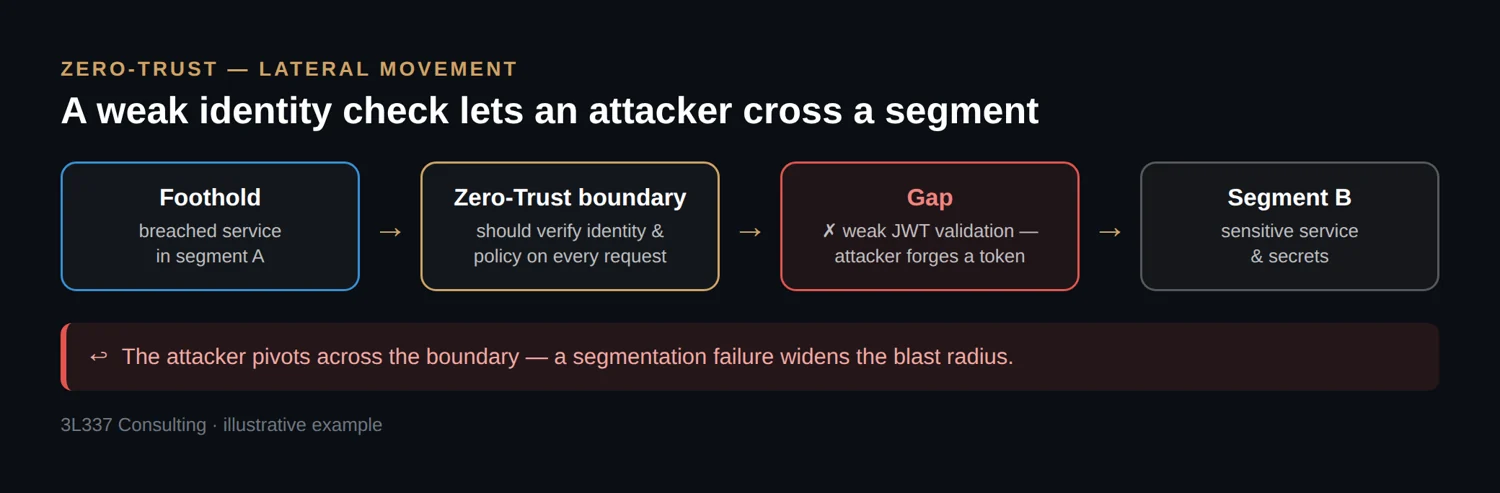
Step 1: Asset and Policy Mapping. Enumerate identities and policies with tools like BloodHound for Active Directory graphs or Azure AD scripts, aligning with MITRE ATT&CK adversary emulation. Test microservices isolation by employing Burp Suite to intercept APIs and verify if a breached service can access others.
Step 2: Authentication Bypass Probes. Target flaws like those in Ivanti CVE-2025-22457, where UNC5221 gained gateway access in March 2025.[^4][^5] Simulate session hijacking or misconfigured auth flows. For example, if JWT validation is weak, forge tokens to cross segments.
Step 3: Segmentation Challenges. Craft packets with Scapy to test isolation. In ZTAs emphasizing microservices, attempt data exfil across boundaries. NIST examples highlight firewall enforcement, but probe for gaps like those in the Zero-Defense pentest, where CSRF on SSH key flows led to SSRF and AWS escalation.[^2][^7] Tool pros/cons: Metasploit excels at exploits but risks detection; custom scripts offer stealth in monitored environments.
Step 4: Post-Exploitation Validation. Establish C2 channels to check monitoring, using tools like Covenant. Vulnerabilities like OpenZiti’s CVE-2025-27501 SSRF underscore admin panel risks in ZTA tools.[^9] Adapt for encrypted tunnels to mimic real threats.
This approach updates traditional network testing to identity-focused attacks, reflecting 2025’s microservices emphasis where segmentation failures, as in Computer Weekly-analyzed incidents, heighten impacts.[^6]
Insights and Recommendations
ZT pentesting uncovers pitfalls like over-relying on segmentation without ongoing validation, as when social engineering often circumvents controls via identity workflow bypasses, per Unit 42 insights.[^11] Misconception: ZTAs are maintenance-free; CISA notes policy complexity leads to drift.[^1] Practical tip: Use Atomic Red Team for quarterly ATT&CK simulations to test bypasses. For microservices, apply OWASP API Security basics, ensuring mTLS and JWT rigor. Pro advice: Incorporate purple teaming for collaborative fixes, avoiding red team silos. Reference specifics like the Zero-Defense blog’s CSRF on SSH key flows to SSRF and AWS escalation chain to highlight real misconfig chains.[^7] I’d love to hear your ZTA pentest war stories, drop them in the comments!
Conclusion
To wrap up, 2025 ZTA pentesting prioritizes microsegmentation and verified bypasses, guided by CISA and NIST, against exploits like the ToolShell chain in SharePoint and Ivanti CVE-2025-22457.[^1][^2][^3][^4][^10] Implications include tighter integrations, but questions linger on balancing granularity with usability. Key reminder: ZTAs shine under scrutiny, so be sure to test relentlessly. What’s your toughest ZTA bypass encounter?
Key Takeaways
- Map comprehensively: Leverage Nmap and BloodHound for identity/policy enumeration pre-attack.
- Probe auth early: Emulate CVE-2025-22457-style bypasses to assess gateway strength.
- Assault segments: Use Scapy/Burp Suite for lateral movement tests in microservices.
- Follow frameworks: Draw from NIST SP 1800-35 for ZTA best practices.
- Simulate regularly: Deploy Atomic Red Team for ATT&CK tactic validation.
- Combat drift: Advocate quarterly policy audits per CISA to avoid gaps.
- Team collaboratively: Purple team to resolve findings swiftly.
[^1]: CISA, “Microsegmentation in Zero Trust Part One: Introduction and Planning,” July 29, 2025. https://www.cisa.gov/news-events/news/microsegmentation-zero-trust-part-one-introduction-and-planning
[^2]: NIST, SP 1800-35: Implementing a Zero Trust Architecture, June 2025. https://csrc.nist.gov/pubs/sp/1800/35/final
[^3]: Microsoft Security Response Center, “Customer guidance for SharePoint vulnerability CVE-2025-53770,” July 19, 2025. https://msrc.microsoft.com/blog/2025/07/customer-guidance-for-sharepoint-vulnerability-cve-2025-53770/
[^4]: Google Cloud Blog, “Suspected China-Nexus Threat Actor Actively Exploiting Critical Ivanti Vulnerability,” April 3, 2025. https://cloud.google.com/blog/topics/threat-intelligence/china-nexus-exploiting-critical-ivanti-vulnerability
[^5]: Picus Security, “UNC5221’s Latest Exploit: Weaponizing CVE-2025-22457 in Ivanti Connect Secure,” May 5, 2025. https://www.picussecurity.com/resource/blog/unc5221-cve-2025-22457-ivanti-connect-secure
[^6]: Computer Weekly, “Zero-trust is redefining cyber security in 2025,” May 29, 2025. https://www.computerweekly.com/opinion/Zero-trust-is-redefining-cyber-security-in-2025
[^7]: Zero-Defense Blog, “How We Gained Full Access to a $100M Zero-Trust Startup,” July 25, 2025. https://zero-defense.com/blog/how-we-gained-full-access-to-a-100m-zero-trust-startup/
[^8]: Reddit r/netsec, “How We Gained Full Access to a $100M Zero-Trust Startup,” July 25, 2025. https://www.reddit.com/r/netsec/comments/1m908uy/how_we_gained_full_access_to_a_100m_zerotrust/
[^9]: NVD, CVE-2025-27501 Detail, March 3, 2025. https://nvd.nist.gov/vuln/detail/CVE-2025-27501
[^10]: Unit 42, “Active Exploitation of Microsoft SharePoint Vulnerabilities,” July 29, 2025. https://unit42.paloaltonetworks.com/microsoft-sharepoint-cve-2025-49704-cve-2025-49706-cve-2025-53770/
[^11]: Unit 42, “2025 Unit 42 Global Incident Response Report: Social Engineering Edition,” July 30, 2025. https://unit42.paloaltonetworks.com/2025-unit-42-global-incident-response-report-social-engineering-edition/