

Research Summary
Recent evidence shows that artificial intelligence (AI) is rapidly transforming penetration testing. In an August 2024 experiment, an AI-driven platform matched a veteran pentester’s success rate (~85%) on 100+ web app challenges in only 28 minutes, compared to the human expert’s 40 hours of work[^1]. Academic studies similarly report that generative AI (GenAI) can streamline labor-intensive steps (scanning, exploit guidance, privilege escalation) while lowering the entry barrier for junior testers[^2]. Pentesters are already leveraging AI for efficiency. For example, a Rapid7 consultant uses in-house language models to draft lengthy security reports and map findings to MITRE ATT&CK frameworks, cutting down tedious documentation time[^3]. However, experts emphasize AI should augment and should not replace human creativity; seasoned practitioners note that no AI can fully substitute the custom tools, intuition, and inventive thinking skilled pentesters bring[^4].
AI adoption brings new ethical and practical challenges. Professionals warn against uploading client data to public AI services due to privacy risks, opting for locally run models and strict data handling policies[^3]. AI’s knowledge is also limited to its training data, so it might miss recent vulnerabilities or produce “hallucinated” outputs, which requires humans to verify and correct its suggestions[^2]. Over-reliance is a danger; researchers caution that unchecked AI could introduce false positives or overlook subtle flaws that a human would catch[^5]. Additionally, AI models can be manipulated by adversarial input or reflect biases in their training, which leads to blind spots[^5]. On the industry front, generative AI is a double-edged sword. In mid-2025, 36% of security leaders admitted GenAI is evolving faster than their teams can secure it[^6]. Notably, cybercriminals are exploiting GenAI too, for example black-market “WormGPT” for automated phishing, which means defenders and testers must adapt in parallel[^7]. These verified insights frame the current state of AI in penetration testing and guide the discussion below.
Introduction
In the summer of 2024, an experienced pentester named Federico was shocked when an AI system solved as many vulnerabilities in half an hour as he did in a 40-hour engagement[^1]. This wasn’t science fiction, and it was a glimpse into how generative AI is supercharging the field of penetration testing. Today, AI-driven tools can enumerate networks, find common flaws, and even write exploit code at a pace that makes traditional one-off testing look sluggish. If you’ve spent late nights combing through logs or writing a 100-page security report, the promise of an AI “coworker” to handle the drudge work is enticing. In fact, some consultants already use custom language models to polish their findings and map them to frameworks like MITRE ATT&CK, which shaves hours off report writing[^3].
The allure of AI in pentesting isn’t just about speed, and it is about amplifying human capabilities. Imagine having an encyclopedic assistant that never tires: it can suggest attack paths, recall obscure CVEs on demand, or quickly parse a mountain of scan data for juicy targets. This can free up testers to focus on the truly creative and sophisticated exploits. However, this new era also raises tough questions. How much should we trust AI’s results? What if the AI gets something wrong, or leaks confidential info? And with attackers arming themselves with generative AI tools[^7], the stakes for defenders are higher than ever. In this article, we explore AI’s growing role in penetration testing, including the opportunities for efficiency and innovation, the challenges and ethical dilemmas, and the impact on our industry. Whether you’re a seasoned pentester or sharpening your skills, now is the time to understand how AI is changing the game (and how to adapt).
Technical Deep-Dive
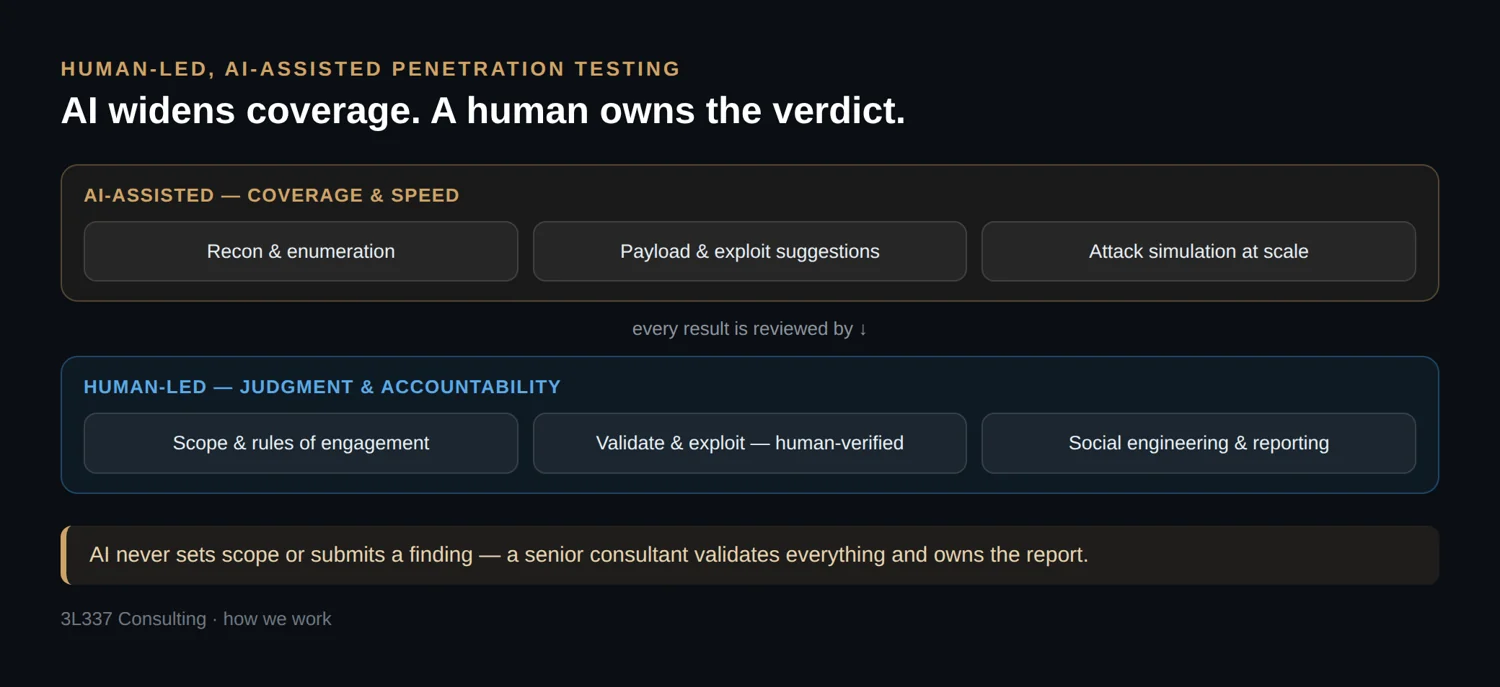
Automating the Mundane: Penetration testing has always involved a lot of tedious, time-consuming work. For example, port scanning, enumerating endless directories, and sifting through output for vulnerabilities are constant tasks. AI excels at these repetitive tasks. Modern large language models (LLMs) can rapidly sift through vast data and highlight what matters. For example, rather than manually reading an Nmap scan’s every line, a tester can feed the results to an AI assistant. The AI might immediately flag that an outdated OpenSSH 7.9 service is running (known to have vulnerabilities), or it might suggest that there is an anonymous FTP login enabled here, which is a likely entry point. In one case study, ChatGPT analyzed scan data and pointed out an exposed Apache default page and an open FTP with no credentials, which a human tester could have overlooked in the noise[^2]. By letting AI handle initial reconnaissance and vulnerability triage, you get a curated shortlist of potential targets within minutes. This dramatically streamlines the recon phase. The AI does in seconds what might take a junior tester hours, all while you sip your coffee.
On-the-Fly Exploit Guidance: Beyond finding weaknesses, AI can help exploit them. Think of it as having an expert technical reference on call 24/7. During a web app test, if you’re unsure how to exploit a noSQL injection or crafting a tricky payload, an AI can offer suggestions. In practical trials, GenAI tools have provided step-by-step exploitation tips: recommending the exact gobuster command to brute-force hidden web directories, or the proper syntax for a hydra brute-force attack against an SSH service[^2]. This kind of advice usually comes from years of experience or lots of Stack Exchange searching; however an AI can pull it from its knowledge base instantaneously. AI assistants are also great at troubleshooting when you hit a wall. For example, a tester attempted to upload a reverse shell that didn’t connect back. The AI suggested using Burp Suite to intercept and find the correct upload path, which led to a successful shell[^2]. It’s like having a second pair of eyes on your attack, ready with alternative ideas when your first attempt fails.
Attack Simulation at Scale: Perhaps one of the most promising developments is using AI for attack simulation and continuous testing. Traditionally, companies might do a pentest once a year, which is a snapshot that leaves plenty of time for attackers in between. AI-driven platforms are changing this by running continuous, automated pentests that mimic human techniques around the clock. For instance, the AI system that matched a top human pentester’s performance did so by systematically working through a benchmark of vulnerabilities non-stop until it captured all the flags[^1]. Now imagine that power integrated into your SDLC: AI bots continuously fuzzing your web apps, checking each code push for common flaws, and even exploiting them in a safe environment to prove they’re real issues. Some enterprise tools already claim this capability. We’re essentially moving toward “Pentesting-as-Code,” where automated agents perform attacks at machine speed, and human testers oversee the process or jump in for the hard parts. This doesn’t mean humans are out of the loop; rather, it augments the team. You could liken it to self-driving cars in security testing, and they handle the highway miles (the routine stuff) while humans take the wheel for the off-road adventures.
AI in the Toolbox: A number of open-source projects and commercial tools are emerging to help pentesters integrate AI into their workflow. For example, PentestGPT is an experimental toolkit that acts as a ChatGPT-powered assistant during tests, guiding users through reconnaissance and exploitation interactively[^5]. There’s even a plugin dubbed BurpGPT that ties a language model into Burp Suite (a popular web vulnerability scanner), with the goal of analyzing scan findings and suggesting next steps. While these are still early-stage, they show the direction we’re headed. Established security frameworks are also getting an AI boost. Some penetration testing service providers now use NLP-driven engines to map discovered issues to MITRE ATT&CK tactics or to generate tailored remediation steps automatically[^3][^5]. Imagine finishing a test and having an AI draft the report for you, complete with attack narrative, MITRE technique IDs, and business-friendly impact statements, all waiting for your review. In fact, one tester reported using an LLM to turn bullet-point notes into a polished, client-ready paragraph with just a prompt[^3]. The time saved on documentation can be reallocated to deeper testing and research.
Remaining Human Elements: Despite these advancements, certain aspects of pentesting remain inherently human (at least for now!). For example, social engineering is a big one, and convincing a target to click a malicious link or give up credentials often relies on emotional intelligence and real-time improvisation. While AI can generate a pretty convincing phishing email, it lacks the accountability and nuance a human operative has when, say, chatting with an employee over the phone to extract info. Similarly, strategic thinking and intuition are difficult for AI to replicate. Seasoned testers develop a “sixth sense” for weird behavior in an app or network that isn’t in any playbook. They might notice subtle logic flaws or design issues that a tool, trained on known patterns, doesn’t recognize. AI also struggles with unknown unknowns. It’s great at exploiting known classes of bugs (buffer overflows, misconfigurations, etc.), but if you throw it into a completely novel technology or a one-of-a-kind custom protocol, it has no past data to draw on. In those cases, human creativity and problem-solving shine. For the foreseeable future, the best results come from human-AI collaboration: let AI do the heavy lifting and suggestion-making, but have a human in the loop to steer the attack, verify findings, and handle the unconventional challenges.
Insights and Recommendations
Treat AI as a Junior Co-Pilot, Not an Autopilot: The consensus from the field is clear. Use AI to assist your work, not to run the entire show. Think of your AI tool like a diligent junior analyst. It can comb through logs, suggest exploits, and even draft reports, but it doesn’t have the seasoned judgment you do. Always sanity-check AI output. If ChatGPT flags a vulnerability, verify it with your own testing before declaring it critical. Likewise, if it writes an exploit script, review the code and test it in a safe environment. This ensures you catch false positives or nonsense (yes, AI can sometimes spout nonsense with confidence). One security consultant put it well: an AI won’t replace the custom scripting and tailor-made tactics that experienced pentesters use; it just handles the grunt work so you have “little bits of efficiency” added to what you’re already doing[^4]. Maintain healthy skepticism. If something doesn’t sound right or safe, double-check with other sources or colleagues.
Protect Confidential Data: A huge ethical consideration when integrating AI into pentesting is data security. By nature, our job deals with sensitive information such as credentials, personal data, and internal system info. Feeding client secrets into a cloud-based AI service is a non-starter (and likely a breach of NDAs). If you use public AI like ChatGPT, sanitize your inputs. Strip out or anonymize any identifiers and sensitive details. Better yet, explore running an LLM offline or on-premises for your engagements. Some firms have already adopted private LLMs in a secure environment so they can get AI benefits without risking a data leak[^3]. Also be aware of model retention: many AI providers save input data to improve the model. That’s a no-go for pentest intel. Opt for solutions that let you turn off data logging or those explicitly marketed as privacy-preserving.
Up-Skill and Adapt: For individual professionals, now is the time to add some AI literacy to your skill set. You don’t need to become a machine learning engineer, but understanding how LLMs work, their limitations, and how to craft effective prompts will go a long way. Treat using an AI tool like learning a new pentest gadget. Practice with it in lab settings. For example, take an intentionally vulnerable VM and use an AI assistant to guide you, so you learn where it helps and where it falters. This will also train you to spot when the AI is going off-track (like suggesting an attack that doesn’t actually apply). Incorporate AI into your methodology gradually. You might start by using it to generate test cases or input fuzz strings. Or use it at the report stage to help outline mitigation recommendations in plain language. By slowly building trust and proficiency with these tools, you’ll figure out the sweet spots where they save time versus where they might waste time. The goal is to make AI a force-multiplier for your expertise, not a crutch that atrophies your own skills.
Stay Informed on AI Threats: Just as we are leveraging AI, threat actors are too, which impacts pentesting strategies. Keep an eye on emerging attack techniques involving AI. For instance, criminals have used generative models to craft extremely convincing phishing lures and even automate malware creation[^7]. This means the “attacker playbook” is evolving. Pentesters may be asked to emulate AI-driven threats (e.g. testing how well a company’s email filters handle AI-written phishing). Be prepared to demonstrate how an adversary with AI might approach an attack, so that you can help organizations bolster their defenses accordingly. Additionally, watch for updates in standards and frameworks: MITRE is expanding knowledge bases for AI-related tactics, and new tools for AI security testing are on the rise. By staying current, you ensure your assessments cover the latest and greatest (or scariest!) techniques.
Policy and Oversight: Finally, organizations should develop clear policies around how AI is used in security testing. Define what data can or cannot be shared with AI tools, and set guidelines for validation of AI-found issues. It’s wise to document when AI was used in a test for transparency with clients or stakeholders. If an AI component is part of a pentest service, clients might ask, “How do we know it’s accurate? What’s the human oversight?” and you should have an answer. Internally, encourage a culture of collaboration where team members share AI tips and failures. If the AI suggested a red herring that wasted an hour, let others know so they don’t fall for it. We’re all learning here, and much like vulnerability knowledge bases, we will benefit from an “AI incident” knowledge base that lists pitfalls and fixes. In summary, approach AI with enthusiasm and caution in equal measure: harness its speed and breadth, but keep your expertise and ethics in the driver’s seat.
Conclusion
AI is undeniably making its mark on penetration testing, accelerating what used to be slow and manual into something closer to real-time. We’ve seen that an AI can already crunch through a week’s worth of hacking in minutes and uncover the majority of the same holes a human would[^1]. That frees us, as testers, to focus on the creatively demanding exploits and the strategic advisory role, which are areas where human insight still outstrips machines. In the near future, [Potential Trend] we can expect AI to handle even more of the routine workload, possibly approaching full coverage of common vulnerabilities. (Some researchers even suggest fully automated pentesting could be conceivable as the tech matures, though this remains to be proven in diverse real-world environments[^5].) What’s certain is that the nature of the pentester’s job will evolve. Rather than being replaced, human pentesters are poised to become orchestrators of AI tools, much like conductors leading an orchestra of tireless bots, while still performing the complex solos themselves.
This evolution brings not just efficiency, but also a broadening of scope. Pentesting will likely extend into testing AI systems for weaknesses, developing new methodologies to probe things like machine learning models and automated decision engines. Our profession has always adapted to the threat landscape, and AI is just the latest seismic shift. Embracing it thoughtfully can make our work more effective and keep us ahead of malicious actors who are certainly exploring the same technology[^7]. At the same time, we must champion ethical guidelines to ensure that the use of AI in security remains responsible, transparent, and respects privacy. As we conclude, one thing is clear: AI is here to stay in cybersecurity. It’s up to us to integrate it in a way that amplifies our capabilities and safeguards our systems. I’d love to hear your experiences: are you already using AI in your pentesting workflow, and how do you see it changing our field in the next few years?
Key Takeaways
- Leverage AI for Efficiency: Integrate AI tools to automate repetitive pentesting tasks (scanning, data parsing, report drafting) and free up time for advanced manual testing.
- Always Verify AI Findings: Never blindly trust AI outputs. Treat them as suggestions, and validate vulnerabilities and exploits with your own tools and expertise to avoid false positives or misses.
- Protect Sensitive Data: When using AI, ensure no confidential client data is exposed. Use on-premise or privacy-focused models, and sanitize inputs to cloud services to uphold ethical data handling.
- Enhance Your Skill Set: Learn to work alongside AI. Develop prompt-crafting skills and understanding of AI limits to effectively supervise and direct AI in your pentest activities.
- Adapt to Evolving Threats: Stay informed on how attackers are abusing AI (e.g. AI-generated phishing, malware). Be ready to test against these AI-powered attack vectors and update your methodologies accordingly.
[^1]: XBOW vs Humans – XBOW Blog (Oege de Moor, Aug 5, 2024). An AI-driven pentest system solved 85% of challenges in 28 minutes, matching a top human pentester’s 40-hour performance. https://xbow.com/blog/xbow-vs-humans [^2]: Al-Sinani & Mitchell, “AI-Augmented Ethical Hacking: Exploitation and Privilege Escalation in Linux” – arXiv preprint (Nov 2024). Demonstrates GenAI streamlining manual pentest tasks and discusses benefits (efficiency, data parsing) and challenges (privacy, hallucinations). https://arxiv.org/abs/2411.17539 [^3]: IT Brew – How GenAI has impacted the role of the pen tester (Billy Hurley, June 13, 2025). Describes a Rapid7 consultant using in-house LLMs for writing professional reports and mapping tactics to MITRE ATT&CK, while safeguarding client data by using local models. https://www.itbrew.com/stories/2025/06/13/how-genai-has-impacted-the-role-of-the-pen-tester [^4]: IT Brew (June 13, 2025). Citing Eric Escobar (Sophos) on not replacing custom pentest tooling with AI: even the best writing/model won’t replace tailored work, though he uses AI for tasks like creating regex filters. Also notes AI is used in moderation to add efficiency, not to handle sensitive data. https://www.itbrew.com/stories/2025/06/13/how-genai-has-impacted-the-role-of-the-pen-tester [^5]: Hilario et al., “Generative AI for pentesting: the good, the bad, the ugly” (2024) – summarized by Fluid Attacks blog (Apr 24, 2025). Highlights AI’s potential to greatly improve pentest efficiency and creativity (e.g. PentestGPT, DARPA’s Mayhem, DeepExploit) and warns of pitfalls: overreliance without human oversight, model bias, and adversarial manipulation of AI. https://fluidattacks.com/blog/gen-ai-in-pentesting-empirical-research [^6]: Cobalt Press Release – State of LLM Security Report 2025 (July 24, 2025). Survey of security leaders finds 36% say generative AI adoption is outpacing their defense readiness; 48% call for a “pause” to recalibrate security. Also notes low fix rates for AI-related vulnerabilities, urging proactive AI testing. https://www.cobalt.io/press-release/cobalt-research-reveals-critical-readiness-gap [^7]: Trend Micro Research – Cybersecurity Threat Brief 1H 2023 (Aug 8, 2023). Reports that cybercriminals are leveraging generative AI (e.g. WormGPT, FraudGPT sold on dark markets) to launch more sophisticated phishing and malware attacks. Emphasizes that the same technology can empower security teams, highlighting the dual-use nature of AI. https://www.trendmicro.com/en_us/research/23/h/cybersecurity-threat-2023-generative-ai.html